Strengthening evaluation through community engagement and volunteerism

One way we build that understanding is by engaging community members, organizational partners, and other interest holders throughout our evaluation work. Their perspectives help us better understand local priorities, challenges, and opportunities.
Some of our most valuable learning also happens outside formal evaluation projects. Volunteering helps our team stay connected to the communities where we live and work. It creates opportunities to support organizations addressing important needs, meet people with diverse experiences, and better understand the strengths and challenges present in our communities.
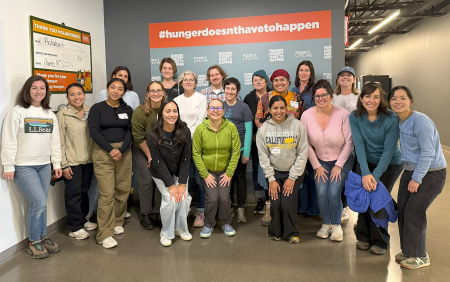
Members of CCHE at Food Lifeline after packaging food to be delivered to local food banks.
This year, CCHE is taking a more intentional approach to volunteer engagement by encouraging participation in opportunities sponsored by our parent organization, Kaiser Permanente, while continuing to support the many ways staff give back on their own.
Some recent volunteer activities include:
- In January, several team members participated in Kaiser Permanente's MLK Day of Service, contributing to community projects across the region.
- In April, staff volunteered at the Seattle/King County Clinic, which provides care for uninsured and underinsured residents throughout the Puget Sound region.
- During our June retreat, the CCHE team spent a morning volunteering at a local food bank, helping sort and pack food for distribution.
Many CCHE staff members also volunteer independently with organizations focused on health care, housing, social services, environmental stewardship, education, food security, and youth programs.
These experiences do not make us experts on the communities we serve. They do, however, help us listen, learn, and stay connected. They remind us that behind every dataset, are people with unique experiences and perspectives.
CCHE's mission is to improve community health through collaborative approaches to evaluation, assessment, and planning. We believe that doing this work well requires both technical expertise and a commitment to understanding community context. Through volunteering, we hope to contribute to our communities while continuing to learn from them.